GOD IS AN OIL PAINTER
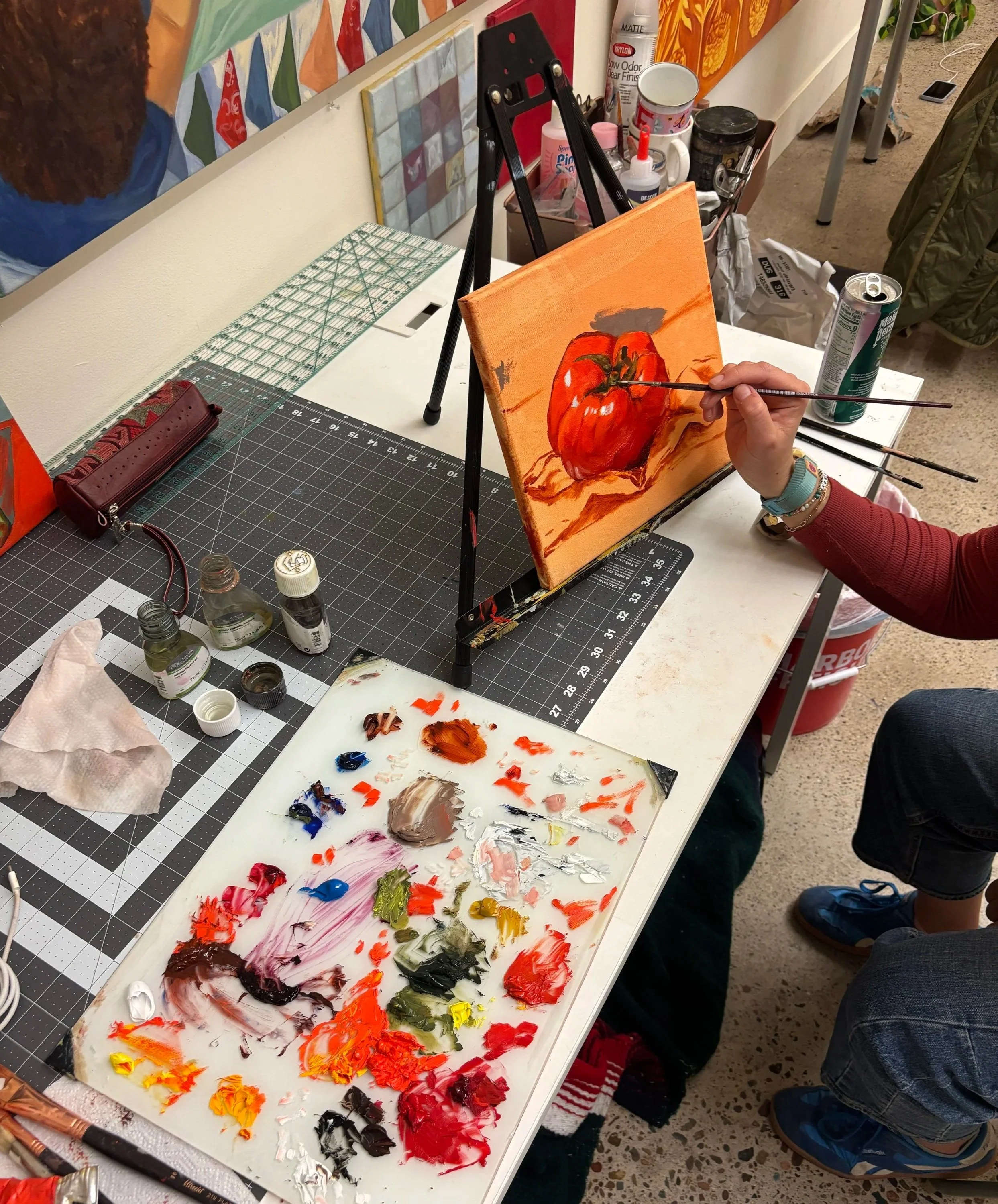
God is an oil painter, I am sure of it.
I have spent my whole life painting with acrylics and although they’re wonderful, after painting with oils for only 2 hours- I just know God uses oils.
There are many ways that acrylic paints and oil paints are different. Acrylic, as I was so famously told by an art teacher, is the most forgiving medium. And she was right. Acrylic is easy to layer and allows the freedom to mess around with very few consequences. It is also significantly cheaper than oil paints and artists can peruse the isles of craft stores to pick the exact shade of any color they’d like. There’s variety, and for me personally, there’s room to make things up as I go along. I really like that acrylic can go on almost any surface- and I give no thought to its process as I apply it to any freshly unwrapped canvas.
Painting with oils however, take thought and intention from the very beginning. Starting with toning the canvas- a process of painting a layer of pigment, burnt sienna or whichever color the artist would like to be underneath the entire masterpiece. Though the majority of it will be covered up, it is crucial the artist choose a hue that will harmonize with what’s to come, because this is what will be seen through any thin layers or gaps in the brushstrokes. Gaps that could be absolutely intentional or perhaps where the paintbrush missed. Either way, with the toning of the canvas whatever is seen will harmonize with the rest of the piece, then comes the sanding. Every canvas even with priming often holds the texture of the cloth its made from, which as I learned, results in a higher volume of surface area. In other words leaving it as is will require and use more paint- exhausting resources quicker than necessary.
And this is where I think we can begin to see that God is an oil painter. Where I am looking straight to the details of how a painting will begin or come together, God is at the beginning. He’s not rushed. He knows I will fall short and there will be areas where I miss the mark- and He’s already covered that. And I, thinking I have no limits and that there is a long list of things I MUST do and become as soon as possible; God pauses. He removes what is unnecessary for my sake, to prepare and preserve for what’s to come. Or maybe because, He, unlike I, knows my limits and insists there is a better way. A lighter yoke. So, He will sand the canvas, because there is no need to do more or prove more. And, He will sand the canvas because it is wise. With a precious resource it is wise to conserve and adhere from being wasteful. And I, in God’s eyes and among His creation am a very, very precious resource.
Once the canvas is ready, so the prep of the palette begins. Oil painters use a limited palette of select pigments. Pigments that transparently don’t inspire me because as an acrylic painter I am used to taking what I need from the shelves. So when I see a palette filled with paints in which the brightest colors are cadmium yellow, cadmium red, and ultramarine blue- I don’t know where to go from there. Even knowing how to mix primary colors, it takes skills beyond me to create the pastels and neon I dream of. The reality is, oil painters work with limited pigments because the quality is significantly higher than acrylics. More expensive, yes, but also the quality of the way they hold together and mix.
I am limited. But, when God looks at that palette- He sees it all. All the potential, all the possibilities. And when I feel incredible lack and limitation, God has all he needs. Which means, I too have all I need.
Since learning that God is an oil painter and I am not, I have also learned I am not the paint. I am not the canvas or even the painting itself- I am the paintbrush. And God will not use me to mix the colors on the palette because there runs the risk of paint getting stuck between bristles. All the potential and all the possibilities and God doesn’t need me to ordain or create those. It won’t be my striving that does it, it will be God’s hand. Often I paint with no plan or sketch or any real reference to perspective but as creative and fun as God is, He’s not making things up as He goes along. He’s not that kind of painter. He’ll do a light underpainting because He has a plan, He always has.
Even here, I would begin to throw paint on the canvas, to begin layering it all, so that I can rush to the details. But here, God marks the canvas with the highlights and the deepest shadows- the reality of where we are and what is going on. He is not unaware ever of our deepest joys and deepest sorrows. And so, the pigments will be mixed and the heart of the painting will be begin, with broad, loose strokes.
It turns out as a painter (as learned in my oil painting lesson), I have a habit of holding the brush to close to its bristles and leaning very close to the canvas. I have a tendency to work in small, swift strokes honing in too much on the details far too soon. Is there any wonder I am stressed and anxious in the ways I am?
Far too concerned with details, far too soon on a painting I don’t even know yet- because let’s not forget! I am the paintbrush, God is the oil painter. The details are secure in the hand of God, so am I.
Not to mention with oils, the details of HOW paint is applied matters. The mere direction of a paint stroke can affect how light hits the painting and the overall feel of it. And if oils are lathered on too fast, too quick, details too soon, it runs the risk of cracking when it all finally dries.
The drying of oil paints can take a few days to a few months… to even a few years. Talk about patience, talk about timing. I may not know when the painting is done, when the painting is dry- but God already knows. God considered it all when He began. It is not a shock to God if anything takes longer than I expect or think it should.
God isn’t rushed. If it takes a few days or a few years, He will accomplish what He began, always. He will never start a painting and give up halfway through. Nor will He look around in confusion, frustrated that it should have been done by now. As if the work He began in your life was yours to finish little paintbrush. An oil painter would never expect a paintbrush to accomplish anything without His hand.
And this is why I know I am the paintbrush, as much as I’ve thought I may be the painting or canvas instead. At the end of painting with oils comes the time to clean the paintbrush. A process that matters and cannot be rushed. If it is, as stated earlier, paint can get stuck at the top of the bristles causing them to fan out and ultimately ruin the brush. Oil paints are cleaned off the brush using turpentine. But sometimes this isn’t enough so it must be rubbed, bristles down on a bar of soap, and then into water. Even then, the paintbrush must be tested, if any pigment comes off on the paper- it must be done again. Even if to the eye no more paint remains, if the pigment is seen on what the paintbrush is applied to; then again. Again and again, however long it takes.
It’s not a one time thing, it’s a process every time paint is applied to brush. Every time. A need to be cleaned every day, cleaned of what can’t always be seen. Just like us- even when we cannot see or understand. A need to allow God to be the oil painter and do what he does best: create. And do what He loves most: being with us and bringing His light and love to the world through us.
God is the oil painter, we are the paintbrush. Really the only thing needed from us is simply this: trust and follow God’s hand.